


Published Factory Metrics: Assessing Industrial Scale and Infrastructure
APEXDURA serves as the dedicated international operational brand of Zhongshan Zhenmei Electrical Appliance Co., Ltd. For institutional buyers conducting desktop audits and factory site assessments, establishing baseline manufacturing capacity, equipment depth, and engineering specialization represents the foundational qualification phase.
Structural Capacity and Operational Context
In B2B contract manufacturing, published operational parameters indicate overall structural capability rather than universal contractual guarantees. The factory premises operated by Zhongshan Zhenmei Electrical Appliance Co., Ltd. encompass integrated manufacturing disciplines including automated metal stamping, precision plastic injection molding, and modular final assembly across 8 production lines.
For appliance brands assessing tier-one vendors, this infrastructure supports high-throughput scalability while minimizing external sub-tier dependencies. The integration of 20+ specialized R&D personnel enables continuous structural design, thermal airflow simulation, tooling optimization, and swift prototyping cycles essential for rapid market penetration.
- Vertically Integrated Operations: In-house tooling development, sheet metal forming, and polymer molding reduce production lead variability.
- Systematic Quality Oversight: Dedicated staging, electrical hipot stations, and in-line operational testing along dedicated conveyor lines.
- Factory Source Transparency: Official factory background and footprint available at APEXDURA Official Website.
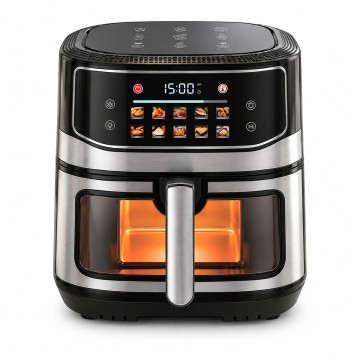
Comprehensive Air Fryer Category Depth & Platform Flexibility
Appliance importers require manufacturing partners capable of supporting multi-tiered product strategies. APEXDURA's engineering platform supports broad market segmentation ranging from cost-engineered mechanical entry units to advanced dual-zone smart connected appliances.
Digital Touchscreen Platforms
Engineered with capacitive sensor interfaces, customizable digital preset profiles, precise micro-controller temperature management, and modern LED/VFD display layouts suitable for contemporary consumer kitchens.
Dual-Basket & Sync-Cook Architecture
Dual-cavity systems offering independent temperature and time controls per zone, synchronized finishing timers (Sync Finish), and dual-zone power distribution balancing peak electrical loads.
Multi-Function Air Fryer Ovens
High-volume countertop convective ovens supporting multi-rack dehydration, rotisserie roasting, baking, and rapid 360-degree vortex air crisping designed for family-sized culinary preparation.
Smart IoT & WiFi Integrations
Tuya/Matter compatible wireless modules, cloud recipe database synchronization, app-enabled push notifications, and remote cooking status telemetry for premium smart home ecosystems.
Robust Mechanical Control Formats
Heavy-duty bimetallic thermostats and mechanical spring timers engineered for intuitive tactile operation, ultra-high durability, minimal PCB dependency, and competitive mass-market retail placement.
Large-Capacity Family Series
Volumetric inner basket capacities ranging from 5.5L to over 10L, utilizing optimized non-stick food-contact airflow racks, engineered basket handles, and balanced center-of-gravity ergonomics.

Evidence-Based Certification Architecture: How Professional Buyers Audit Compliance
Compliance is verifiable evidence, never a generic blanket claim. In international electrical appliance trade, assuming an entire facility holds universal certification across every individual SKU is a high-risk error for purchasing executives. Legitimate OEM factories present model-specific certificates corresponding to designated target jurisdictions.
The official APEXDURA platform showcases compliance documentation across major international standards, including CE, ETL, CB, RoHS, and LFGB. However, serious commercial buyers must execute formal regulatory due diligence prior to purchase orders:
- Model-Specific Scope: Verify that the exact model number, internal thermal rating, heating element wattage, and critical PCB revisions match the certificate test report.
- Accredited Issuing Bodies: Confirm reports originate from recognized testing laboratories (e.g., TUV, Intertek, SGS) and maintain current validity on accredited portals.
- Food Contact Material (FCM) Rigor: Basket non-stick PTFE/ceramic coatings and silicone bumpers must have dedicated LFGB (EU) or FDA (US) extraction test reports.
The 13-Stage Production Sequence: From Raw Alloy to Global Delivery
A transparent manufacturing process is the single best predictor of consistent lot-to-lot reliability. APEXDURA follows an institutionalized 13-stage manufacturing roadmap ensuring engineering discipline from demand intake through after-sales support.
Demand Analysis & Concept
Market parameter definition, capacity targets, target price positioning, culinary heating profiles, and functional ergonomics.
Tooling & Mold R&D
CAD/CAM structural engineering, thermal airflow fluid simulation, runner layout design, and precision steel tooling fabrication.
Raw Material Procurement
Strict incoming material specifications for engineering PP/ABS granules, food-grade aluminum coils, and electronic components.
Sample Production & Lab Test
Engineering pilot samples, rapid prototyping, thermal chamber endurance, drop testing, and electrical dielectric breakdown tests.
Metal Stamping Execution
Automated punch-press metal forming for inner heating liner chambers, reflective shields, and stainless basket components.
Plastic Injection Molding
High-tonnage injection machines molding aesthetic outer housings, handle grips, decorative trims, and structural chassis bases.
Pre-Production Line Prep
Workstation calibration, jig and fixture alignment, Poka-Yoke mistake-proofing validation, and component staging along lines.
Continuous Assembly Line
Sub-assembly of motor-fan modules, heating coil mounting, wire-harness routing, and sequential chassis enclosure fastening.
100% In-Line Electrical Testing
Automated high-voltage insulation (Hipot) checks, earth continuity, ground bond verification, and power draw calibration.
Packaging & Barcode Labeling
Drop-tested molded pulp/polystyrene cushioning, multi-language retail color boxes, master carton strapping, and barcode serialization.
Final QA / Pre-Shipment Inspection
AQL-based sampling protocol verifying cosmetic finish, functional cooking performance, label adherence, and barcode readability.
Warehousing & Export Logistics
Dry finished-goods palletized staging, container load optimization, ocean manifest preparation, and customs compliance clearance.
OEM & ODM Customization Scope: From Private Labeling to Custom Tooling
Whether launching an entry-level retail brand or building a bespoke, patentable flagship appliance, hardware customization requires clear scope alignment. APEXDURA separates OEM/ODM development into structured engineering layers that balance tooling capital, time-to-market, and brand differentiation:
- Industrial Design & CMF: Custom Pantone/RAL injection masterbatches, matte, gloss, metallic UV coatings, brushed stainless steel accents, and heat-resistant electroplating.
- UI / UX & Control Electronics: Custom front panel graphics, localized typography, screen printing, custom icon iconography, and tailored MCU buzzer chime frequencies.
- Electrical & Market Localization: Dedicated heating elements configured for 100-127V 60Hz (North/South America, Japan) or 220-240V 50/60Hz (Europe, UK, Australia, Middle East) with certified regional plugs.
- Retail Packaging & Collateral: 5-ply corrugated gift boxes, ISTA-standard drop test packaging layouts, multilingual user manuals, and customized recipe books.
Review the comprehensive bespoke development parameters on the APEXDURA OEM/ODM Engineering Gateway.

Strategic Evaluation Checklist: What Appliance Buyers Must Verify On-Site
Before issuing requests for quotation (RFQs) or committing working capital to pilot tooling, global sourcing directors should systematically verify prospective manufacturing partners against standardized manufacturing maturity criteria.
1. Traceability of Key Components
Examine how the factory tracks lot numbers for critical safety parts: heating elements, thermal cutoffs (thermostats), fan motors, and power cords. Full bill-of-materials (BOM) traceability is essential for recall mitigation.
2. Food-Contact Integrity
Inspect non-stick application lines and curing ovens. Request verifiable raw supplier certificates of analysis (COA) confirming coatings are free from unauthorized heavy metals, PFOA, and hazardous polyfluoroalkyl compounds.
3. Tooling Maintenance Program
Assess tool room capabilities: preventative maintenance logs for multi-cavity injection molds and progressive metal dies directly affect dimensional consistency over 100,000+ pressing cycles.
4. Thermal Uniformity Validation
Review internal testing laboratory capabilities: multi-channel thermocouple dataloggers should map heat distribution across all basket zones to prevent uneven crisping and excessive exterior chassis skin temperatures.
5. Export Packaging Validation
Verify random-vibration and drop-testing procedures simulating international maritime transit. Poor packaging design results in bent basket rails, cracked handles, and unacceptable return rates at retail distribution centers.
6. On-Site Showroom & Audit Access
Top-tier suppliers welcome on-site physical audits and technical exchanges. Review APEXDURA's international delegation hosting on the Global Buyers Factory Visit Portal.
Initiate Your Air Fryer Manufacturing Project
Whether you need an existing platform configured with localized regulatory credentials or require ground-up custom tooling development for an innovative product launch, APEXDURA’s engineering team is ready to evaluate your product brief, market destination requirements, and commercial schedule.